We can’t help it! Donald John Trump is again the chief of world imperialism. Is Trump a good representative of the U.S. capitalist ruling class? He is not only a capitalist but also a large landowner.
Given that the primary focus of this blog is economics, it is essential to address both of Trump’s roles.
The Trump Organization, his main enterprise, appropriates surplus value by buying land in Manhattan (New York City) and other large urban areas. It hires construction companies to erect skyscrapers that increase in height in alignment with the continually escalating urban ground rents. As these rents climb, the Trump family gets richer.
No need to bother to create new industries like 19th and 20th-century robber barons like Andrew Carnegie (the modern steel industry), John D. Rockefeller (oil), Thomas Edison (the electric industry), Henry Ford (the auto industry), and Steve Jobs (the computer industry).
In addition to real estate, Trump has also made money in the gaming industry — running casinos where the house always wins. Once, this was run by gangsters. The biggest gangsters are capitalists forced to operate outside the law — men like Meyer Lansky. (1)
However, with time, the gaming industry has become legal, allowing legal businesses like the Trump Organization to take over. Despite its now legal nature, the stink of gangsterism has always surrounded Trump. Today, he is even formally, according to capitalist law, a convicted felon, though it’s a good bet that once he’s president again, he’ll have that overturned by the higher courts. As for the federal cases against him, they are now dead in the water because as soon as he enters the White House on January 20, 2025, he will order the cases to be dropped if they aren’t already in the closing days of the Biden administration. As president, according to a recent Supreme Court ruling (with three members previously appointed in his first term), he can commit any crime as long as it is part of his official presidential duties. (2)
Trump didn’t personally create his real estate-casino business empire. He inherited it from his father, Fred. Trump symbolizes in his own person one of the most repulsive features of capitalism and class society in general: hereditary wealth and privilege. As is well known, Trump is a vulgar racist and misogynist. One of his best friends (if a man like him can have friends) was the late sexual predator Jeffry Epstein. Though, to be fair, another U.S. president, Democrat Bill Clinton, was also a friend of Epstein. On October 27 this year, Trump held a rally in Madison Square Garden that featured not the normal Republican post-Jim Crow dog whistle racism but raw in-your-face racism. Trump didn’t himself engage in its crudest forms, but he clearly relished it.
We can answer whether Trump is a good representative of the U.S. capitalist class in its decaying phase. Despite some ineffective attempts to stop him by the “Party of Order” — he is! It’s said that people get the leaders they deserve, and the decaying U.S. capitalist class certainly deserves Donald Trump.
The roots of his second administration are found in the first one. Though he lost the popular vote by about two million votes in 2016 to his opponent, Hillary Clinton, he carried the electoral college. According to formal democracy, Trump had no right to be president, but he was legally entitled to the office due to the electoral college system.
Millions of people were so outraged by Trump’s undemocratic though legal victory in 2016 that mass demonstrations against him developed at once, even before he took office. I remember attending one such demonstration about 48 hours, or perhaps only 24, after he was declared the winner in San Francisco. A huge crowd gathered on a warm late autumn evening, and for hours, we marched through the streets, denouncing everything he stood for.
Once he was in office, the demonstrations continued. They included Arab Americans, Muslim Americans, Jewish Americans, African Americans, Latinos, women defending abortion rights, LBGTQ+ people defending gay rights and opposing gay-baiting, people outraged by Trump’s promise to repeal “Obamacare” and instead demanded healthcare as a basic human right; men and women of science and the arts who opposed the ignorance that Trump both encouraged and in his own person represented.
Under the pressure of a growing movement, just enough Republicans came to the rescue of Obamacare, a policy that began as a Republican alternative to healthcare as a human right, also sometimes called single payer in the U.S. Speaking from personal experience, participating in these demonstrations was a heart-lifting experience. Everything good and creative in the world seemed united in fighting the forces of ignorance and reaction that Trump represents.
But there was a problem. A class-conscious working-class movement did not lead it; progressives dominated it. Progressives are well-meaning people, but they do not understand class. As a rule, they represent the interests of the middle class (called the petit bourgeoisie in traditional Marxist language), whose economic position is intermediate between the working class that produces surplus value and the ruling class that lives off surplus value.
Because of their class position, progressives cannot understand the economic laws, especially the law of the value of commodities, which rules the capitalist economy regardless of the will of individuals. This fatal weakness allowed the Democratic Party to take over leadership of the anti-Trump movement. In 2016, Democrats said the answer to the horrible new president was to defeat the Republicans; first, in the mid-term elections of 2018, this was achieved, and then in the election of 2020, this was also achieved.
It wasn’t only progressives (and the still relatively few Marxists in the U.S.) who opposed Trump. The capitalist class’s core political leadership, comprised of Democrats and Republicans, also opposed him. This is usually called the establishment, which I have dubbed it the Party of Order, borrowing an expression used by Karl Marx in his pamphlet “Class Struggles in France, 1848 to 1850” and “The 18th Brumaire of Louis Bonaparte.”
At first, the Party of Order hoped they could tame Trump. However, though he was and is pro-capitalist to his bones and has all the capitalist class instincts, he also has ideas that sometimes conflicted with the Party of Order. One example is his brazen-in-your-face racism, which can be seen as too provocative in a country that is expected to have a non-white majority by the mid-2040s. The Party of Order believed Trump undervalued NATO, showed insufficient support to the Nazi-ridden Euromaidan coup government in Kiev, tried to end a shooting war that’s still being waged in northeastern Syria, and tried to end the U.S. war against Afghanistan prematurely.
By the time election season approached in 2020, the Party of Order had had enough of Trump and united around the campaign of Joseph Biden as its hand-picked candidate. Biden was a conventional imperialist politician who had spent his entire life serving U.S. imperialism and its Party of Order, supporting every U.S. imperialist war. In 2020, a new generation of activists, misled by the progressives, knocked on doors and encouraged anyone who was anti-Trump — the majority of the people — who could legally vote to show up at the polls and defeat Trump by voting for Biden. Though the victory was narrow in the electoral college, Biden was victorious by a margin of seven million votes.
Unlike his predecessors, Trump refused to admit defeat in 2020. He falsely claimed the election was stolen from him and plotted to find a way to stay in office by illegal means. This is without precedent in U.S. history.
On January 6, Trump spoke to a far-right armed mob that marched to Congress and stormed the building, chasing out the assembled Representatives, Senators, and Trump’s own arch-reactionary vice president, Mike Pence.
The two houses of Congress and Pence had assembled to carry out their purely ceremonial but constitutionally mandated duty to certify the electoral college vote. The National Guard that was supposed to protect the Capitol was strangely absent. For hours Trump refused to call off the mob and seemed to approve of the mob’s calls to “hang Mike Pence.” The mob even built a scaffold and rope to do just that. Perhaps this was meant to be symbolic, but many members of the mob who viewed Pence as a traitor to Trump wanted to do just that. Trump is reported to have said that Pence “deserved it.”
The Senators and Representatives and a shaken Mike Pence were furious. Articles of Impeachment were hastily drawn up by the House of Representatives and passed with the votes of Democrats and Republicans alike. A majority in the Senate voted to convict him and throw him out of office. However, the Senate vote fell short of the constitutionally required 2/3’s super-majority. As his term was to expire, Trump would be out of office within two weeks anyway. More importantly, if he had been convicted he could have almost certainly been banned from “holding an office of trust in the United States” and would have been banned from ever holding office again.
Unfortunately for the Party of Order, there were just enough Republican Senators who, however much they despised Trump (it seems that anybody who has ever had dealings with the man despises him), feared they would lose office at the hands of pro-Trump voters they needed to win reelection in the future.
But in those days, this hardly seemed to matter as Trump was forced to slink out of Washington and fly to his luxury home in South Florida, one of many he has. Now four years later he is president-elect again. Unlike in 2016, this time he won in the electoral college and carried the majority of the popular vote, the first Republican to do so since 2004 when George W. Bush was still basking in the afterglow of the events of 9/11.
The real story of the election
While the final figures aren’t in as I write these lines (Nov. 10), if we examine the numbers, we see that Trump’s votes did not increase from that of 2020. The still incomplete count shows his votes either dropped slightly or stayed about the same. Relative to a rise in population this indicates a decline of support. He should have been soundly defeated in this election ending his presidential and Bonapartist ambitions forever.
But the Democratic vote collapsed by about fourteen million. There was no upsurge in votes for Trump. Rather the Democratic collapse is the real story of the election of 2024. As the saying goes, the fish rots from the head down. Democrats generally did better down the ticket. Many Democratic voters refused to vote for Biden’s vice president, Kamala Harris, but voted for other Democrats and progressive ballot measures such as protecting abortion rights on a state level and raising the minimum wage. In the popular vote, Trump did not so much win as Kamala Harris lost.
Some frustrated young African-American men — but not African-American women — and somewhat more frustrated Latinos did vote for Trump. The reasons for this (especially the class composition of this vote) should be examined. Trump’s vicious opposition to “illegal” immigrants — he is promising to deport them by force as soon as he assumes office — no doubt won him some working-class votes among Latino workers and to a lesser extent, among African Americans and many more among white workers. As long as workers see no prospects for a socialist revolution as a realistic near-term alternative, competition among workers as sellers of labor power rages on, and opposition to “illegal” immigrants by right-wing politicians will receive a hearing.
Among Arab Americans and Muslims, two groups that overlap but are not by any means identical — many Arab Americans are Christians and many non-Arab Americans are Muslims — many in frustration did vote for Trump. But many others voted third party — for Jill Stein of the Green Party, Claudia de la Cruz of the Party of Socialism and Liberation, and independent activist Cornel West.
The reason for this is not hard to explain. It can be described in a single word: GAZA. And the bombing and invasion of Lebanon meant that Lebanese Americans who had been part of the anti-Trump vote in both 2016 and 2020 refused to vote for Harris. No wonder! In addition to the Gaza genocide Lebanon itself is being bombed and leaders are being murdered by the Zionist entity killing many women and children and other non-combatants in the process.
Still, if all the Arab and Muslim votes that went to Trump in this election had gone for Harris instead, it would not have changed the outcome of the election. Many progressive pro-Democratic commentators draw the conclusion that Gaza — from their point of view is regrettable but not decisive — did not determine the outcome of this election.
But this too overlooks that it wasn’t only Arab and Muslim Americans who joined the demonstrations and sit-ins against the Biden administration’s direct support of the Gaza genocide. If Gaza had not occurred, or if the Biden-Harris administration had not financed it, provided the weapons to carry it out, supported Israel in the United Nations, and wined and dined Netanyahu in Washington as the genocide continued, a lot of young people would have voted for Harris. But after the genocide very few if any of these young people could stomach voting for “killer Kamala.” In the final days of 1968, LBJ’s vice president and the Democratic presidential candidate Hubert Humphrey tried to put some distance between himself and LBJ. How sincere he was is another question that is not important here. What is important is that the race suddenly tightened and Humphrey almost defeated Richard Nixon.
In contrast, Harris never said anything to disassociate herself from Genocide Joe in any way. When asked what she would do differently than Biden the only thing she could think of was a promise that she would appoint a Republican to her cabinet! She went out of her way to campaign with Liz Cheney, the daughter of George W. Bush’s Vice President Richard Cheney, who many see as the real author of the Iraq and Afghanistan wars. By campaigning with Cheney, she was saying I couldn’t care less about Arab and Muslim lives. (3)
Not only did Harris do nothing to disassociate herself from Genocide Joe, but she also did everything to associate herself with the warmongering blood-stained, and thoroughly discredited George W. Bush administration. That administration has around a million dead Iraqis on their conscience — assuming they have one. And this is not to mention the Afghanis who died in the twenty-year-long shooting war against Afghanistan that the Bush-Cheney administration started.
Many people who did not join the anti-genocide demonstrations were profoundly affected by them. How many of these overwhelmingly young people, Arab, Christian, Muslim, and Jewish voted for Harris? I would imagine not very many.
But it doesn’t stop here. How many misguided youth would have volunteered for the Harris campaign, knocked on doors to get out the vote, and made sure that Trump did not return to the White House? But after Gaza, these youth, as well as the slightly older generation that had done this in 2020 to throw Trump and all he stands for out of the White House did not knock on any doors for Killer Kamala. It cost Harris more votes than the numbers who turned out for the demonstrations, big and small, national and local put together.
Some Arab and Muslim leaders in the United States as well as abroad who, of course, cannot vote in U.S. elections, argued that the Democrats should be punished for the unspeakable crimes that party has committed against the people of Gaza and throughout the rest of Palestine and the Levant beyond Palestine, Yemen, and Iran. Anybody who has any human feelings at all can sympathize with that reaction. Refusing to vote for Harris was not only a moral thing to do but also the correct political thing.
However, the Democratic Party is not a naughty child who misbehaves and needs to be punished to grow up and learn. The Democratic Party is an instrument of the imperialist capitalist ruling class of the United States. Unlike a child, the Democratic Party can be pressured but cannot learn like the class it represents cannot learn. Like the class it represents it is the creature of the economic laws that rule the capitalist system. It will continue committing crimes as long as it exists and the class it represents exists. This is the lesson that all scientific political economy and the Marxist critique of it teaches.
Some other reasons that Harris lost
In addition to Gaza, the punishing inflation that followed the COVID shutdowns and the consequent fall in the standard of living of the working class took a toll. The policies adopted by the Trump administration to ease the situation confronting the working class such as mailing out so-called stimulus checks, the child tax credit, and steps that limited the rights of landlords to evict people, and providing free vaccines without requiring medical insurance, were ended under Biden.
The Biden administration formally supported but failed to push the Pro-Act that had it passed would have repealed the 1947 Taft-Hartley Act. The same goes for the Voting Rights Act, which would have banned Republican voter suppression policies mainly aimed at African Americans. This legislation would have improved the electoral prospects of Democrats. But the Democrats didn’t pass it. And the list goes on. One piece of legislation that the Biden administration passed was the CHIPS Act, a neo-mercantilist piece of legislation designed to maintain the U.S. monopoly on high tech against the growing challenge of Chinese industry. It is part of the economic war with China that threatens to turn into a shooting war that could be the grave of civilization.
Unemployment at record lows?
During the campaign, the Biden-Harris administration boasted about the 800,000 new manufacturing jobs it supposedly created. Many of these jobs simply reflect the snapback of the economy after the COVID shutdowns. These shutdowns caused inflation, breeding shortages. As the shutdowns were lifted businesses scrambled to rebuild their inventories — and their staffs.
During the shutdowns, unemployment soared to double digits, levels not seen since the Depression of the 1930s. As the shutdowns ended, hiring soared — for a while. But this relatively short-lived hiring splurge is far behind us with even official unemployment again over 4%. This has not prevented Democratic Internet progressives from pointing to the great record of the Biden-Harris administration on job creation. For example, the Young Turks’ Cenk Uygur — a bitter opponent of Trump and rightly so — keeps repeating his claims that “unemployment is at record lows” without being corrected, as far as I have seen by the other progressive TYT commentators.
If unemployment is really as low as Uygur keeps claiming, why do homeless encampments keep springing up in major cities while real wages remain lower than they were fifty years ago? If Uygar were correct about unemployment being at record lows, competition for workers among the bosses and the decline of competition for jobs among workers would be pushing up real wages allowing them to get jobs at living wages and afford the rents that the landlords are charging.
In addition to the money the capitalist must advance to the workers in the form of wages that the workers use to buy the commodities they must consume to reproduce their labor power, the bosses must also advance an additional sum of money to pay the urban ground rent workers must pay in varying forms as well as the taxes that fall on wages. TYT commentators rightly point out that “establishment” Democratic politicians live in a Washington bubble. What they don’t realize is that they too are living in their own bourgeois class bubble.
Trump was able to gain votes by saying he would deport all “illegal” immigrants in the U.S. even among a few African Americans and more Latinos, because unemployment is not at record lows. He was able to take political advantage of the competition among workers who were individually trying to sell their labor power to whatever capitalist buyer they could find. If all “illegal aliens” were expelled from the labor market individual workers would face less competition.
If unemployment was really low, competition among workers for buyers for their labor power would decline. Then the promise to expel “illegal” immigrants by reactionary politicians would lose its effectiveness, especially among members of oppressed nationalities. The only way to overcome the effectiveness of the arguments by reactionary politicians to expel immigrants is not to hope for the “arrival of genuine full employment” but to rebuild the workers’ movement not only in the labor unions but on the party level. This would enable workers to think of themselves as a class that can liberate humanity from capitalism and not as sellers of the only commodity they have to sell, their labor power. Here trade union consciousness is not enough.
The gains by the far right are not a purely U.S. phenomenon. We have seen it in recent elections in Italy and France and, considering 20th-century history, most chillingly in Germany. As I write these lines, the news comes that a coalition government of the Social Democratic Party, the extreme neoliberal Free Democrats, and the ecologists of the Green Party (what an unprincipled bloc) has collapsed. This means Germany faces a new general election. In recent elections, the right-wing nationalist Alternative for Germany made major gains. What will the coming election for the Bundestag, German parliament, election bring? We will know soon enough.
Is fascism on the march?
Vice President and now defeated Democratic presidential nominee Harris described Trump as a fascist. There are reports that Trump admires Adolf Hitler and has kept a copy of Hitler’s Mein Kampf near his bedside. I have no idea whether this is true, though I would not be surprised if it were. Does he believe in fascist ideology? This is the wrong way to approach this question.
The truth is that fascism has no particular ideology. In the 20th century, fascism was not an ideology but a mass movement. In class terms, it pitted middle-class youth organized in militia formations in a civil war against the labor unions and workers’ political parties, especially the Communist Parties that were part of the Third International, but also the Social Democrats. In Spain, General Franco indicated that he was willing to kill half the Spanish people to rescue Spain from communism — that is, the workers’ movement. He proved as good as his word. The ideology the fascists used in Italy, Germany, Spain, and other European countries was whatever would serve the fascist movement. All the fascist movements used nationalism and chauvinism. Love of country, as we say in the United States. But the love of country is not specifically fascist.
One of the most sinister elements of the ideology German fascists used was extreme antisemitism. This casts a deep shadow on our own time because the resulting genocide of European Jews paved the way for the creation of the State of Israel. This has led to the current genocide in Gaza. One genocide led to another. What role did antisemitism play in the German fascist movement and its genocidal antisemitism?
There is nothing specifically fascist about antisemitism. Its roots go back to the ancient world and the Christian gospels. There were antisemites long before the rise of so-called National Socialism as the German fascists described themselves, but there was nothing specifically fascist about it.
Italian fascism that came to power in 1922 made little use of antisemitism. Many Italian Jews were members of or supported the fascist movement. Jews were well represented in the Italian middle class that was the base of the fascist movement. Only in the late 1930s, when fascist imperialist Italy fell under the domination of a far stronger fascist imperialist Germany did the Italian fascists adopt antisemitism as an ideology. Even then, Italian fascist antisemitism never approached the levels of Nazi Germany.
What was the real origin of the murderous Nazi antisemitism that led to the genocide of the European Jews? Antisemitism, though not anything like the Nazi kind, was indeed widespread in pre-World War I Germany. Before World War I middle-class Jews often voted for the German Social Democratic Party, not because they were really socialists, but because all the bourgeois parties were officially antisemitic.
Biographers of Hitler — who actually came from Austria and lived there before the war — show that he had friendly relations with individual Jews. He may well have been antisemitic even then but it was of the mild pre-World I variety. The young Hitler was already an extreme German nationalist who hated the Social Democratic movement and hated the Slavic Czechs who were formerly equal to the Germans in the Austria-Hungary empire. How could Slavic people be equal to Germans like the young Adolf Hitler in German Austria? This enraged him. Just before the war Hitler moved to Germany and joined the army as soon as the war broke out.
The U.S. entered the war in 1917, and in the summer of 1918, a German offensive in France failed. More importantly in November 1917 under the leadership of the Bolshevik party, the working class seized power in Russia.
The German officer corp, who generally came from the Prussian landowner class, was terrified that the Russian revolution would spread to Germany. German workers in uniform had enough of the war and in 1918 rose in revolution. The officer corp decided that they had to surrender to the allies — the United States, France, and Britain — to avoid the fate of their counterparts in Russia. How would the generals explain their decision to surrender to the allies to the middle-class non-commissioned officers? The NCOs included a certain then still unknown corporal, Adolf Hitler. The officer corp wondered what the reaction to this surrender would be, which included accepting the Treaty of Versailles, which meant that Germany accepted sole guilt for the war (this was far from the truth), and agreeing to pay reparations that threatened to wreak havoc on the German economy?
The German officer corp loved their country like they loved their Lord and Savior Jesus Christ. But they loved their capital (that’s capitalism, not the city of Berlin) and landed property even more. Given the choice between the two, they chose capital and landed property. But how could they explain this to the NCOs? The problem was that, as a rule, the middle-class NCOs owned very little capital and landed property, and their love of country exceeded their love of capital and land, which they didn’t have.
What the officer corps did was hand over the government to the Social Democratic Party, which they had long hated. They told the Social Democrats to sign the Versailles Treaty. Then they turned around and told the NCOs that the “Marxists” of the SPD had betrayed Germany.
But the officer corp couldn’t blame the workers, who were German after all. Weren’t the workers a vital part of the country they loved so much? Ah, but wasn’t Karl Marx a Jew? And were Jews like Marx really German? And hadn’t the Jews murdered their Lord and Savior Jesus Christ? Hadn’t the “Jewish-controlled” Social Democratic party misled the workers turning them away from love of country in favor of anti-German working-class internationalism? Isn’t internationalism a Jewish idea?
So the officer corp told the middle-class NCOs that Jews were behind the Social Democrats. It was Jews who had betrayed Germany and told the Social Democratic government to sign the Treaty of Versailles. The previous relatively moderate and Christian conventional antisemitism of the NCOs now gave way to blind murderous hatred. And nobody was more passionate among the NCOs than Corporal Adolf Hitler who completely identified himself with Germany.
Hitler’s blind and deadly hatred of Jews was born. He wasn’t alone among the NCOs who had few prospects in defeated post-World War I Germany. German fascism was born with all the disastrous consequences we feel to this day.
Now, let’s flash forward to the years of super-crisis of 1929-32. The leaders of German imperialism — Germany’s very own Party of Order — knew they would have to fight a war of conquest against the Soviet Union in the not-too-distant future. This would be a commercial war like the war against the Allies, but also a class war. If they fought a war against the Soviet Union, the German Party of Order knew it would first have to fight a civil war within Germany that would crush the working class organizations. But who could serve as the army to wage the civil war on behalf of the capitalists and landowners? It was Hitler and his brown-shirted militias.
The German Party of Order landowners hoped to lure Hitler and his mass fascist movement into a coalition government where Hitler would be subordinated to the Party of Order in a kind of right-wing version of the popular front. But Hitler was no fool. He was willing to participate in such a right-wing “popular front” government but only if he had the top post of Chancellor.
After some resistance, the Party of Order agreed and Hitler became Chancellor on January 30, 1933. The Party of Order surrounded Hitler within the cabinet with its men. Hitler however had a mass movement behind him organized in a mass militia movement. Within a few months, the Party of Order was pushed aside and Hitler became dictator. The rest is history. There’s much more to say, but I am now out of space. I will continue this next month. Now, let’s return to the economic events that led to the crash of 2008.
Gold production
Last month we examined how changes in the level of gold production affect the capitalist economy. Like all other branches of capitalist commodity production, gold production is governed by changes in the profitability of producing gold relative to the profitability of other branches of production. Like in all other branches of production, the industrial capitalist that produces gold starts with a sum of money, M, and purchases means of production and labor power that alone produces surplus value. At this point, some peculiarities arise.
Gold production consists of two production processes. One is mining gold ore and the other is refining it into bullion. These are sometimes carried out by a single industrial capitalist or sometimes by separate ones. The final product, uncoined bullion, is money material, although gold also has other use values.
Gold bullion is mixed with trace amounts of other elements to strengthen it. Like abstract human labor that gold in terms of its own use value measures, gold is a homogeneous physical substance, while abstract human labor is a homogeneous social substance. As a social substance, abstract human labor, the substance of value, can be subdivided to the mathematical limit of infinity or at least to the smallest unit of time that the laws of physics allow. This is not true of gold since it cannot be subdivided below the atomic level without ceasing to be gold. But gold approximates infinite divisibility sufficiently at the level of reality that economic science deals with.
Gold is a physical substance, the element Au on the periodic table. As a chemical element, gold reacts very little with other elements to form compounds making it virtually immortal on the scale of the lifetime of the capitalist system.
It is an ideal substance to represent money capital in that it can be accumulated side-by-side with other forms of capital throughout the lifetime of the capitalist system. Gold also has use values other than representing money material.
During high demand, the need for gold as the money material is partially met by harvesting gold that was previously used for non-monetary purposes.
Whenever gold is in unusual demand stories abound of people pulling gold out of their teeth filings. Along the same lines, the Nazi regime during World War II extracted gold from the teeth of concentration camp victims and melted it down into gold bars deposited at the Reichbank, as Germany’s central bank was then called.
More recently, during exceptional demand for gold, it has often been extracted from old electronic boards and transformed into bullion. This is easier to achieve with gold jewelry. Just because a piece of gold is used for some other use value than money material does not mean it cannot be transformed into the money material.
Assume the same industrial capitalist carries out the gold mining and refining. The gold capitalist begins with M, a sum of money the industrial capitalist aims to turn into M’. With the initial M, our gold capitalist buys the elements of productive capital, machines, auxiliary materials, and, not least, labor power, which alone produces surplus value. M consists of gold and our industrial capitalists aim to end up with more gold than they started with.
Under modern conditions, this is disguised by the fact that a gold mining company won’t use actual gold bullion but commercial bank credit money that is convertible on demand of the owner into legal tender currency issued by a central bank that we know represents gold in circulation. So the fact that the gold capitalist is producing the commodity that is already money capital as soon as it is produced without being sold is disguised under the present monetary system. Gold appears to be just another commodity, not a special money commodity.
What the gold capitalist will not have to purchase is raw material. Just like the case with non-money commodities, the raw material in gold mining — gold ore — is a product of nature and not human labor. Gold ore in the ground or elsewhere is not a product of human labor and has no value. Under the capitalist system when gold is mined it becomes a product of both direct and indirect human labor and acquires value. The extracted gold then must be refined into bullion and acquires additional value. If a separate gold refining capitalist is involved, the unrefined gold will have the value and function of raw material for the gold refining capitalist.
What makes the gold capitalist different from all other capitalists is that the product is already money material as soon as the two production processes — mining and refining — are completed. The gold capitalist’s commodity capital is their money capital without having to be sold. The private labor that produced the commodity capital is unlike the labor used to produce other commodities directly social labor. A commodity whose private labor is already a part of social labor without having to be sold — exchanged for a money commodity or its representative in circulation — is money material.
Again, under modern conditions the gold capitalist — we assume the gold miner and gold refiner are a single industrial capitalist — will sell the gold for commercial bank-created money. In the days of the gold coin standard, gold capitalists sold the bullion to the central banks or the government mints in exchange for commercial bank-created credit money and somewhat earlier for central bank-issued banknotes, another form of credit money, and still earlier for gold coined money.
Today, gold capitalists sell bullion for commercial bank-created credit money giving rise to the illusion that it isn’t the gold that is money but rather the commercial bank credit money or the legal tender central bank-issued money that the commercial bank credit money is convertible into. Over long periods, only gold bullion or coins and jewelry can function as a means of accumulation of money capital. All paper money in contrast has been devalued or depreciated sooner or later. So if you want to hold money material long term and accumulate additional money material as capital — the only way you can really do this is to hold the money commodity itself — gold.
Overproduction of gold
Can gold be overproduced? A school of Marxist thought claims it can’t and I once supported that view. On further reflection, I decided this view is false.
Any human society has to have a mechanism to distribute the total quantity of labor, measured in some unit of time, among the various tasks that must be performed to reproduce society. To use an example used by Engels in “Socialism: Utopian and Scientific,” some portion of the total labor available to society has been assigned to the production of buttons while another portion has been assigned to the production of shirts. If the total labor time is not assigned correctly, we might have too many shirts but not enough buttons for the shirts produced; or too many buttons but not enough shirts.
Different societies solve the problem of distributing the total quantity of labor available to society among the various tasks that must be performed in different ways. Under capitalist commodity production — all capitalist production is commodity production though not all commodity production is capitalist production — this is achieved by the fluctuation of commodity prices around the prices of production of the given commodities that are produced. Prices of production are the prices that equalize the rate of profit in all branches of production so that capitals of equal sizes in equal periods yield their owners’ equal profits. Prices of production are modified direct prices, direct prices are the price that directly equalizes prices with values.
If a given commodity is overproduced, the market prices of that commodity will fall below its price of production. This will signal the capitalists to produce less of that commodity.
For example, if we assume shirt buttons are being overproduced relative to shirts there will be a glut of buttons on the market. The market price of buttons will fall below their price of production. Suppose however that too little of the labor available to capitalist society is being devoted to button manufacture. Then the market price of buttons will rise above their price of production. Capital, always searching for profits above and beyond the average rate, will flow into the button-making industry. A portion of the total social labor not involved in the button production will be shifted into it, ending the shortage.
What is poorly understood by Marxists today is that all types of prices, including cost prices, prices of production, and market prices, must always be expressed in terms of the use value of the money commodity. Assuming the money commodity is gold, its use value is measured in some unit of weight.
Cost prices, prices of production, and market prices are measured in terms of weights of gold. Currency units like U.S. dollars, pounds, euros, yen, rubles, yuan, etc. always represent specific weights of gold at any given time. In some periods, the state fixed the amount of gold a currency unit represented through the monetary authority. In other periods such as the one we have been in since August 1971, the amount of gold the currency units represent is allowed to fluctuate.
This gives rise to the illusion that currency units somehow represent value independently of gold and that gold has a price in terms of currencies such as the dollar. Even Anwar Shaikh falls victim to this illusion. In reality, the very category of prices of production and market price makes no sense unless they are measured in terms of the use value of some money commodity. Behind commodity prices in paper currencies, including the U.S. dollar, there are always lurking prices in terms of weights of gold.
Communist versus capitalist production
Capitalist production must devote a certain portion of the total labor time available to producing money material, which we assume is gold. However, producing a specific money commodity is not necessary for all types of social production. A communist society run by the associated producers will not need to devote a portion of the total social labor at its disposal to produce a special money commodity. Instead, the proper disposition of the total social labor among the various tasks the associated producers must perform will be determined through a common plan worked out by the associated producers to meet their common needs.
But capitalist society must devote a certain portion of the total labor time at its disposal to produce a commodity whose use value serves as money material. This need arises not because of any physical need of production itself, as with shirts and shirt buttons, but because of the anarchic nature of capitalist production that capitalism inherited from its simple commodity production ancestor. I have shown throughout this blog that when capitalist society devotes too little of the total social labor at its disposal to the production of money material, the result is the general overproduction of non-money commodities relative to the money commodity. This ends in economic crisis and mass unemployment.
But can the opposite occur? Can capitalist society devote too much labor to producing the money commodity? Let’s examine the common phase for a particularly profitable line of business as “a gold mine.” This means that the demand for the commodity produced by this line of business is so strong that the sale of the commodities at or above the prices of production of the commodity that it produces is virtually guaranteed for a certain period. The gold miner and refiner are in just such a position. The gold miner-refiner doesn’t have to worry about selling the gold to make a profit because gold is already money.
For this reason, if industrial capitalists could choose any line of business they wanted, they would all choose gold mining and refining. By choosing gold mining and refining, they still have to produce commodities containing surplus value. What they don’t have to worry about is the realization of surplus value because realized surplus value — profit — is measured in terms of the use value of their commodity.
But what would happen if all industrial capitalists shifted to the gold-producing industry? Capitalist society would find itself in the position of King Midas and would perish. We can’t eat gold, after all.
Indeed, if all industrial capitalists began to shift toward the production of gold, the capitalist economy would break down long before the shift was completed. Commodity after commodity, shirts and shirt buttons alike, would find themselves in short supply, and their prices — in terms of gold — would soar. So would the cost price — like all prices, measured in terms of weights of gold, including the cost price of producing gold — soar? The gold capitalists would have to lay out more gold to produce additional gold. They would start to lose money, just like any other type of capitalist that has overproduced their particular commodity.
This is what happens in the real world long before capitalist society gets anywhere near the position of King Midas — starting with the crisis and continuing into the stagnation/depression phase that follows the crisis proper — when capitalists start to overproduce gold.
The overproduced gold piles up in huge stagnant hoards. A classic example of this is the Great Depression of the 1930s. According to the quantity theory of money, prices measured in terms of gold should rise sharply at this point. In reality, however, the overproduction of gold that begins with the crisis is simply making up for the previous underproduction of gold that preceded the crisis. Just like individual businesses have to rebuild their balance sheets, capitalist societies have to rebuild their consolidated balance sheets by devoting a much greater portion of the total labor available to producing gold.
Eventually, however, the depression of (non-money) commodities in the economy will mean that the total quantity of non-money commodities measured in terms of the use values that are appropriate to them will shrink. As the multiplier and accelerator effect takes hold, prices of non-money commodities in terms of gold begin to rise. Unlike before the crisis, plenty of money is now available to support a rise in prices. As commodity prices rise toward and then beyond the prices of production, the cost price of the gold capitalist rises, and the period of extraordinary profits they have been enjoying ends. The fall in the rate of profit to and then below the average rate of profit is the signal to the industrial capitalists that they have been devoting too much labor to the production of money material than capitalist society needs.
A renewed underproduction of gold must now make up for the overproduction of gold. The underproduction of gold makes up for the previous overproduction. In this way, the regulation of the production of money material by the law of the value of commodities is no different than the regulation of the production of any other commodity.
However, because of the unique nature of its role as a use value of money, the production of money material involves certain special features that are not found in the production of any non-money commodities. When the supply of a non-money commodity lags behind the need of capitalist society for a greater quantity of the money commodity, the market price of that commodity rises above its price of production. The industrial capitalists producing that commodity realize an extra profit beyond the general rate of profit. The higher-than-average profit rate attracts additional capital, which leads to an increase in the supply of that commodity.
When the numbers of commodities produced both in terms of their use values measured by a unit appropriate for that use value and their price tags measured in terms of some unit of gold, the need for money as a means of circulation — currency — increases. Though gold itself does not generally function as a means of circulation in today’s capitalist economy, the ability of the central banks to issue increasing quantities of currency without the additional currency depreciating and triggering currency-depreciation inflation depends on a rising level of gold production. If the demand for gold is too strong to avoid currency depreciation at existing interest rates, the rate(s) of interest must rise. As we have seen, everything remaining equal, the demand for money material — we assume gold — varies inversely with the rate of interest.
Periods of boom feature rising prices and rising interest rates. As long as the rise in interest rates is not too rapid and the long-term rate of interest remains below the average rate of profit, allowing a positive profit of enterprise, the boom continues. However, the continuing boom creates a need for additional means of circulation. Under modern conditions, the means of circulation consist mostly of commercial bank deposits, which are the main form of credit money in an advanced capitalist economy. However, the ability of commercial banks to create money depends on the quantity of legal tender money that the central banks create. And the ability of central banks to create additional legal tender money without the legal tender money depreciating in turn depends on the rate of growth of the quantity of gold — money material.
Despite the illusion that the ability of central banks and commercial banks to create additional means of circulation measured in terms of their purchasing power is completely divorced from the rate of the production of new gold, the ability of central banks to create additional currency measured in terms of its purchasing power remains closely tied to the quantity of new gold that is being produced. In turn, the ability of the commercial banks to create additional imaginary deposits — credit money — is also through the mediation of the ability of the central banks to create additional legal tender money — which is ultimately determined by the level of gold production. As the quantity of commodities increases, the need for additional currency to circulate the rising quantity of commodities increases. A booming economy increases the need in capitalist society for additional gold.
However, the rising prices of non-money commodities far from stimulating the production of additional gold on the contrary depresses the production of gold. The reason is that from the point of view of the industrial capitalists that produce gold, the rising prices of commodities mean a rising cost price for them. The rising cost price means that producing material money reduces their rate of profit both absolutely and relative to the rates of profit in other branches of capitalist industry.
Indeed, if the cost prices of producing money material keeps rising, at some point profits in the money material industry will be wiped out altogether. As the need of capitalist society for the production of additional gold to back up the needed additional means of circulation increases it raises a signal through the language of profit — the only language the industrial capitalists understand — to produce less money material.
This isn’t just a random glitch in the market; it is rooted in the essential characteristics of commodity production.
Once capitalism reaches a certain level of development, the imperative to reduce the production of money material — when capitalist society needs money material — will be reproduced repeatedly on an increasingly larger scale.
The underproduction of gold does not lead to an immediate crisis precisely because of the previous overproduction of gold caused by the previous crisis.
The greater the preceding crisis, the greater the previous overproduction of gold. The long boom after the 1930s Great Depression is the classic example of this. The velocity of currency can be accelerated, excess reserves of idle money capital in the banks can be mobilized, and credit can replace money as a means of purchase. A greater economy based on the need for currency can be achieved, for example, by increasing the quantity of money that is concentrated in the hands of the banks, as compared to quantities of currency that may also be lying idle in the hands of the public.
However, replacing money with credit as a means of purchase will at some point increase the demand for money as a means of payment, while the possibility of increasing the velocity of circulation will reach its limit. Interest rates will then rise while the ability of the central banks to create additional legal tender money measured in terms of their purchasing power will be paralyzed by a rising demand for gold fueled by the growing underproduction of gold.
This demand can only be checked by still higher interest rates that at some point, will wipe out the profit of enterprise altogether. Eventually, the crisis erupts, and the profitability of producing non-money commodities temporarily collapses. Lower prices in terms of gold by reducing the cost price of producing gold will finally restore the the rate of profit of producing money material. The rate of profit in the money-material-producing industry then rises absolutely, even more so relative to the production of non-money commodities.
Only at this point do the industrial capitalists get a signal from the market in the language of profit to produce more money material. The underproduction of gold turns into the overproduction of gold. However, the accelerated production of gold occurs only as the circulation of commodities contracts, which temporarily reduces the need of capitalist society for additional means of circulation. As the need for additional gold to support additional means of circulation declines — though this is offset to a certain extent by the sharply increased demand for additional means of payment — the demand for gold is now equalized with the supply of gold at lower and lower interest rates. The more that production of non-money commodities is curtailed, the more excessive is the production of gold relative to now falling needs of circulation, and the more the demand and supply of gold are equalized at lower and lower interest.
Under the present system of unconvertible paper money, another complication arises. If a significant degree of currency depreciation inflation is developed, this will create a considerable rise in inflation profits when calculated in terms of paper currency as opposed to profits measured in terms of the use value of gold. The production of non-money commodities seems profitable to the industrial capitalists even though these profits are not real.
These fictitious paper money profits cannot be maintained because they rely on ever-accelerating inflation that, if not checked, would destroy the currency completely. To avoid this, the central banks must, at some point, stabilize the currency by restricting the rate at which they are creating additional legal tender currency — for example, the Volcker shock. Currency stabilization by whipping out fictitious paper money profits stimulates the production of gold. In this way the brutal logic of the law of the value of commodities asserts itself.
Because of the anarchy of production characteristic of capitalism, disproportions in the production of commodities are inevitable. To use Engels’s example, these disproportions are like producing too many shirt buttons and not enough shirts or producing too many shirts and not enough buttons; they appear to be mere accidents. However, the periodic underproduction of gold, followed by the overproduction of gold, is not an accident but is the inevitable consequence of capitalist production.
The nature of crises
Finally, are capitalist crises, crises of the underproduction of money material relative to the production of (non)money commodities or are they crises of the overproduction of commodities relative to the production of money material? The quantity of money material — gold production — never shrinks but only expands, taking the world as a whole. This is true even if individual gold atoms are never destroyed; some gold is lost for all practical purposes when gold coins circulate from hand to hand causing minute quantities of gold to rub off. Over time the coins grow light in circulation.
This can become a major problem when a significant quantity of the currency consists of gold coins. While gold reigns supreme as a measure of value and profit, it makes for a poor currency. Currency functions best when it is not made of gold. As capitalism develops, gold is increasingly retired as currency. There is also the possibility that gold that functions as money material might be used for other purposes, such as electronics or dentistry, which reduces the quantity of gold that functions as money material. But annual gold production, even during periods of depressed gold production, more than makes up for any such losses.
At the beginning of every capitalist expansion, there is much more gold than is necessary to support a renewed expansion of capitalist production and circulation. Since the total quantity of gold in the world never falls but only rises — though at variable rates — the only way a new crisis of overproduction can occur is by an even faster rise in the quantity of non-money commodities — measured in terms of their price tags.
This is why the peak of production at the top of all capitalist nations’ industrial cycle always exceeds the previous peak. It is more accurate to speak of the cause of the crisis as a general relative overproduction of commodities — relative to the total quantity of gold in the world — or overproduction of commodities rather than an underproduction of gold relative to (non-money) commodities. Either way we look at it, crises of overproduction are caused by the fact that capitalist society, in a period of economic boom, devotes too little labor to producing additional money material. And this is not an accident caused, for example, by a depletion of gold mines, though this can be a factor in a particular crisis.
Any commodity can be underproduced relative to other commodities under capitalism. The symptom of this is the rise of market prices above the price of production. Depending on the specific use value of the commodity in question capitalist reproduction is more or less disrupted when this happens.
If the use value of the commodity is trivial, at least from the viewpoint of the capitalist reproduction process taken as a whole, the disruption in capitalist reproduction is minimal. If it’s crucial for capitalist reproduction, such as in the case of energy-containing commodities or food commodities, the disruption in the reproduction process will be considerable.
However, when it’s the money commodity that is produced in insufficient quantities, the impact on reproduction is massive. Workers in their tens of or even hundreds of millions across the globe are thrown out of work. This is all the more striking because the role of gold within the production process is so limited. The reason that an underproduction of gold is so disastrous is that capitalist reproduction is a unity of both production and circulation. The circulation of commodities is only possible with their production. But the reverse is also just true. The production of commodities is not possible without circulation. This is why Marx devoted one book in his unfinished draft of “Capital” to the production of commodities — Volume I — the only part of “Capital” that was published in Marx’s lifetime — and another book on reproduction, Volume II of “Capital.”
In the anarchic economy of capitalism, disproportions between the different branches of production are as inevitable as they are accidental. However, due to the very nature of the money relationship of production, the periodic disproportions between the production of money material and the production of all other commodities are not accidental but must be reproduced on an ever larger scale.
Indeed, of all types of commodities produced under capitalism, there are two special commodities that capitalism cannot do without. One is the commodity labor power, which alone produces surplus value. No production of surplus value, no profit, no profit no capitalism.
The other special commodity is the money commodity — gold — that alone makes the circulation of commodities possible. No circulation of commodities, no production of commodities, no production of surplus value, no profits, no capitalism. This explains the mysterious power that gold — a mere metal — seems to have over human beings in a capitalist society.
Each successive industrial cycle begins with a surplus of gold that represents the overproduction of gold that occurs during and after the crisis phase of the industrial cycle. Before a new crisis can occur there must be a renewed overproduction of commodities relative to gold and this overproduction must develop to a certain point before a new crisis can occur.
Crises and the depletion of gold mines
As we saw above the periodic underproduction of gold relative to non-money commodities can be explained without making any assumptions about the depletion of gold mines. Capitalist reproduction itself periodically and on an increasing scale reproduces shortfalls in gold production without any assistance from the depletion of gold mines.
However, gold as a chemical element exists in the earth’s crust in only limited amounts. The continuing demand of capitalist reproduction for ever more gold means that the business of digging and then refining gold-bearing ores into gold metal knows no limit, even if the exact demand for gold varies within the industrial cycle.
Indeed, the continuing demand of capitalist reproduction — the unity of both capitalist production and capitalist circulation — means that the capitalist need to expand the “above-ground gold supply” rises toward the limit of infinity.
Nature, however, generates gold as a chemical element in distinctly limited quantities.
Obeying capitalism’s truly unlimited demand for additional gold production, technology is developed that makes the extraction of gold from the earth’s crust ever more powerful. However, inevitability, at a certain point this technology runs up against the limits established by nature. So far, the capitalist gold mining industry has continued to find ways to increase gold production further. For example, there is talk about mining the ocean bottoms for gold. Since our planet is three-quarters covered by oceans, it seems probable that there is more gold ore under the oceans than on dry ground.
The ecological consequences of mining the ocean bottoms for gold to meet capitalism’s unlimited thirst for ever-increasing quantities of this commodity threaten to be disastrous. Beyond that point, there is the possibility of mining asteroids and other extraterrestrial bodies for gold. However, the possibility of doing it profitably still seems some way off, to say the least. The limits on the velocity that massive objects can achieve, established by the law of special relativity discovered by Albert Einstein, means that the gold ore on planets, moons, and asteroids beyond the solar system will forever remain safe from earth-based capitalism’s unlimited demand for additional gold.
There is the possibility of producing gold by bombarding heavy elements like mercury with neutrons, but the depletion of the gold mines of the solar system would have to progress far before this would be profitable. Under capitalist production, it is not enough to increase the quantity of gold measured in some unit of weight. This must be done in such a way that it is sufficiently profitable for industrial capitalists to produce the additional gold.
If rich new gold mines are discovered — there were claims a few years ago that a great deal of mineable gold exists in Uganda but this has not been verified — the price of production of commodities measured in terms of the use value of gold will increase. If this happens, capitalist production will be stimulated until the market prices in terms of gold rise to higher levels or until the new mines are depleted. As market prices adjust to the new lower value of gold, the rate of profit will be temporarily greater when measured in terms of the use value of gold than when measured in terms of the value of commodities.
But what happens when the opposite occurs? Gold mines become depleted, which causes the prices of production measured in terms of gold to fall. As market prices measured in terms of gold — we are not interested in paper money prices here — fall toward the new lower prices of production, and the rate of profit in terms of gold will be temporarily much lower in gold money terms than in value terms.
It so happens that the crisis of 2008 provides a classic example of this process.
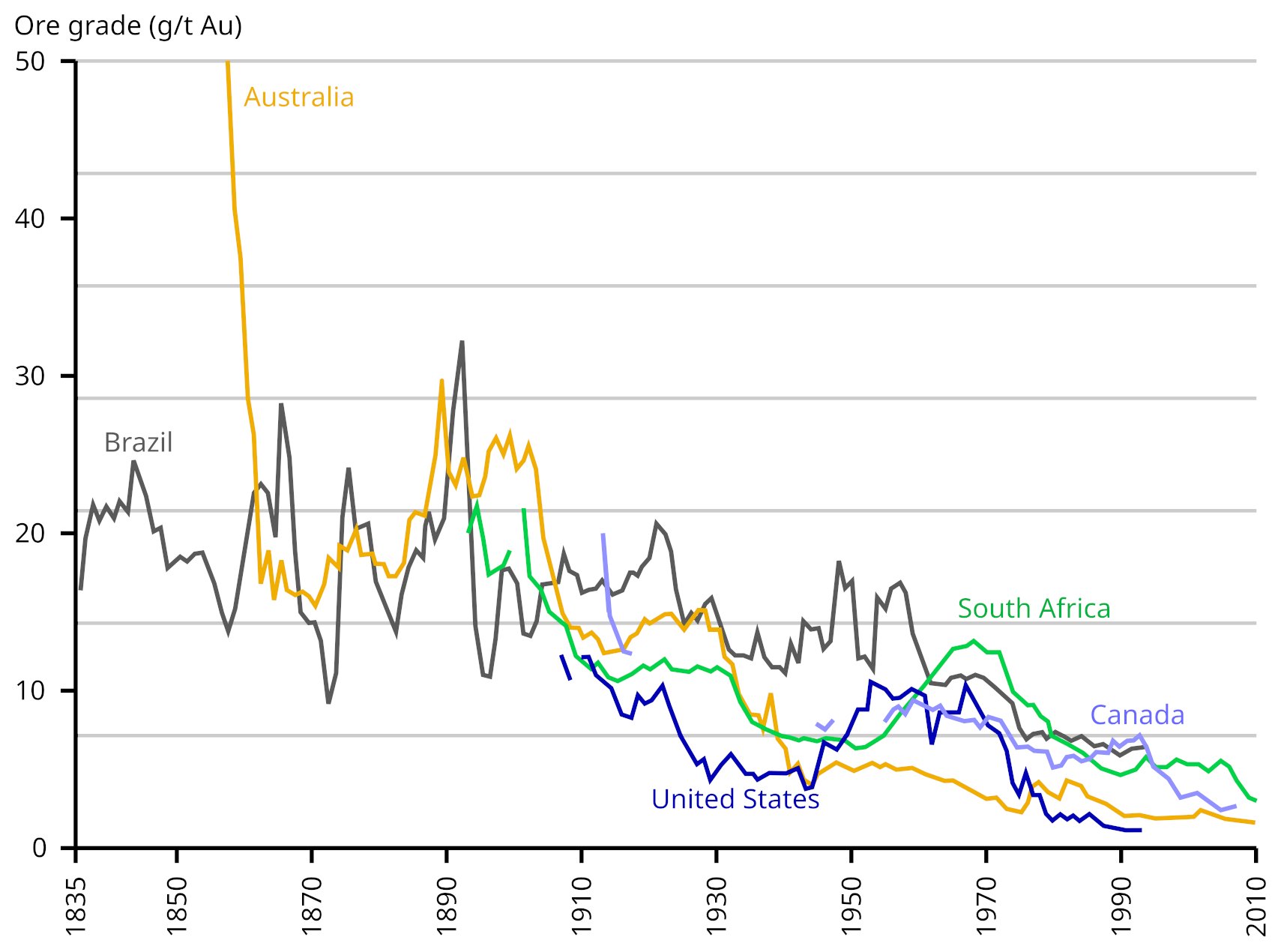
This graph illustrates the evolution of gold ore grades from the Gold Mining entry on Wikipedia and demonstrates the decline in the richness of gold ore extracted from 1835 to 2010. From the turn of the 1880s to the turn of the 21st century, South African gold mines were the largest source of new gold.
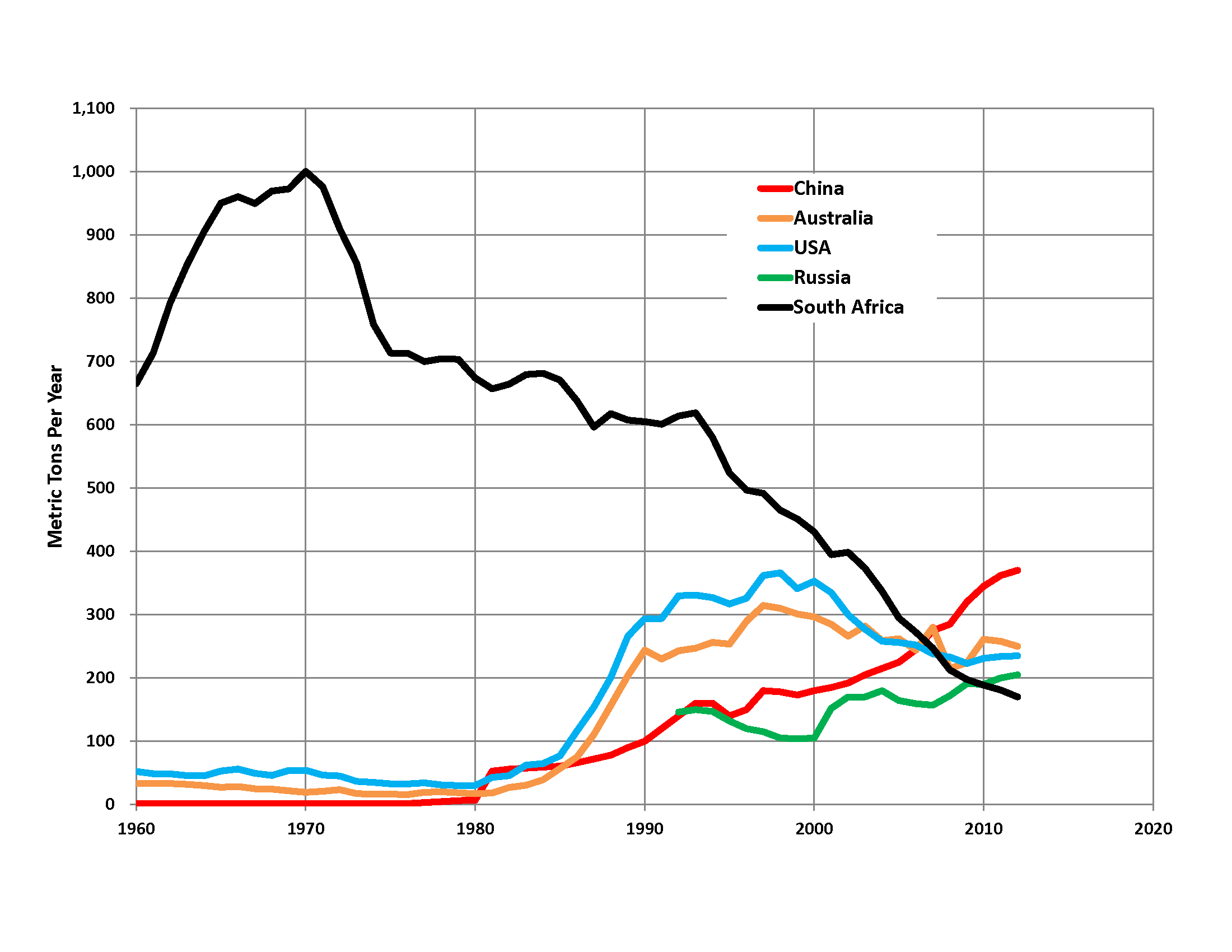
The top five gold producers graph shows the production of the five gold producers from about 1960 to shortly after 2010, just after the crisis of 2008. Russian gold production is listed only after it became a capitalist country in the 1990s. It doesn’t show the Soviet Union’s production of gold.
The interesting fact about the graph is the evolution of South Africa, the largest single capitalist producer of gold, before the crisis of 2008. South Africa’s production of gold rose from around seven hundred metric tons per year around 1960 to one thousand metric tons around 1970. However, after 1970, the production of gold fell steeply, back to around seven hundred metric tons in the late 1970s. As the price of commodities in terms of gold in the 1970s fell sharply, the rate of decline of gold production in South Africa slowed. But there was no recovery. Gold production simply declined at a slower pace.
In the late 1980s and early 1990s, South African gold production stabilized at a level of around six hundred metric tons. However, in the second part of the 1990s, the decline resumed, falling below 200 metric tons by around 2010.
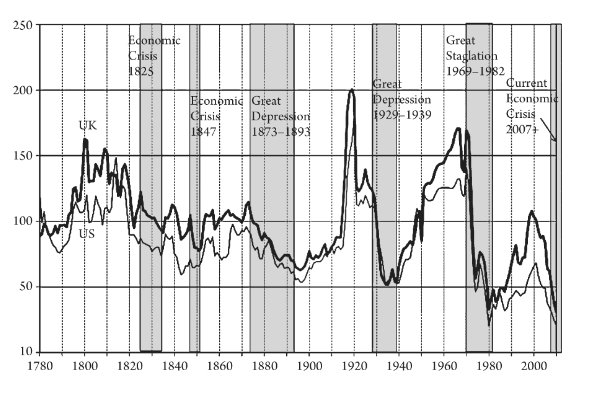
The industrial capitalists responded to the depletion of gold by developing gold mines in other countries. The fall of the prices of commodities in terms of gold (see graph from Anwar Shaikh’s “Capitalism,” page 64) made these mines that would have been unprofitable before profitable.
But by then South African gold production was the lowest of the big five gold producers, with China replacing South Africa as the largest gold producer at just under 400 metric tons, Australia in the number two spot at around 250 metric tons, the USA at about 250 tons, Russia at just over 200 tons, and South Africa last of the big five at just under 200 metric tons.
Despite the fall in the prices of commodities in terms of gold, the depletion of South African gold was so strong that even the huge fall of prices in terms of gold in the 1970s and the more modest fall in the golden prices of commodities after 2001 could not revive the South African gold producing industry. If South Africa had been the only gold-producing country, world capitalism would have faced far more severe crises than the crises it faced between 1968 and 1982 and again in 2008.
It is possible that in the absence of the development of gold mines outside of South Africa, an even more radical reduction of the price of commodities in terms of gold would have still bailed out capitalism though at the cost of a far worse crisis. We should not forget that the lower the prices of commodities in terms of gold, the greater the commodity circulation that can be supported by a given quantity of gold.
If the gold mines that have now largely replaced the gold mines located in South Africa become depleted as the South African mines over the next few decades, and no new mines are found somewhere else or if there are not enough dramatic improvements in our ability to extract gold from much poorer ores, capitalism will be facing far worse crises in the current century.
To be continued
(1) Meyer Lansky (1902-1983), along with his close friend Charles Luciano (1897-1962), began as a street gangster in New York City’s Lower East Side. Along with Luciano, Lansky helped organize the syndicate, also known as organized crime or the mob. Lansky developed into a large capitalist who specialized in the gaming industry. Along with another of his boyhood friends, Ben Siegel, he helped transform the once-obscure Nevada town of Las Vegas into the world-famous “Sin City” it is today. Lansky reached the pinnacle of his success in prerevolutionary Cuba, where he was a close associate of the Cuban dictator Fugencio Batista. He was an early loser in the Cuban revolution and one of the first to denounce Fidel Castro as a “Communist” — he turned out to be right on that, after all — and lost much of the capital that he had accumulated during his career in the gaming industry and the mob. (back)
(2) In reality, this has long been the de facto law in the U.S. Richard Nixon needed a pardon from his successor, Gerald Ford, to escape prosecution for his Watergate crimes. However, he needed no such pardon to escape prosecution for his far more serious crimes in Vietnam and the rest of Indochina that caused the death of millions of people because the crimes were carried out as part of his official duties as president. The Supreme Court’s recent decision that a president, even after he leaves office, cannot be prosecuted for crimes committed as part of official presidential duties means that if the Supreme Court ruling had been in effect at the time, Nixon might have also been able to escape prosecution for his Watergate crimes without Ford’s pardon. Nixon’s truly Bonapartist doctrine that it’s “legal if the president says so” is pretty much now the law of the land. (back)
(3) Iraq is an overwhelmingly Muslim and majority Arab country. Afghanistan is not an Arab country but it is also overwhelmingly Muslim. (back)
 A Critique of Crisis Theory